Carbon Fiber vs. Aluminum: An In-Depth Material Comparison
For us, the handlebar is the critical interface connecting your body to the ground. Every pull, push, and turn demands a perfect balance of strength, weight, and rigidity. When considering a handlebar upgrade, we may face a question: should we opt for the lightweight, vibration-dampening carbon fiber mtb handlebars, or stick with the traditionally durable and more affordable aluminum mtb handlebars?
This is more than just a material choice; it’s a decision that decides heavily on your riding style, budget, and performance requirements. Today we are discussing specific brands or modes. Other than that, we will discuss about material difference, hoping this will help you to make your decision to find the best MTB cockpit component for your needs.
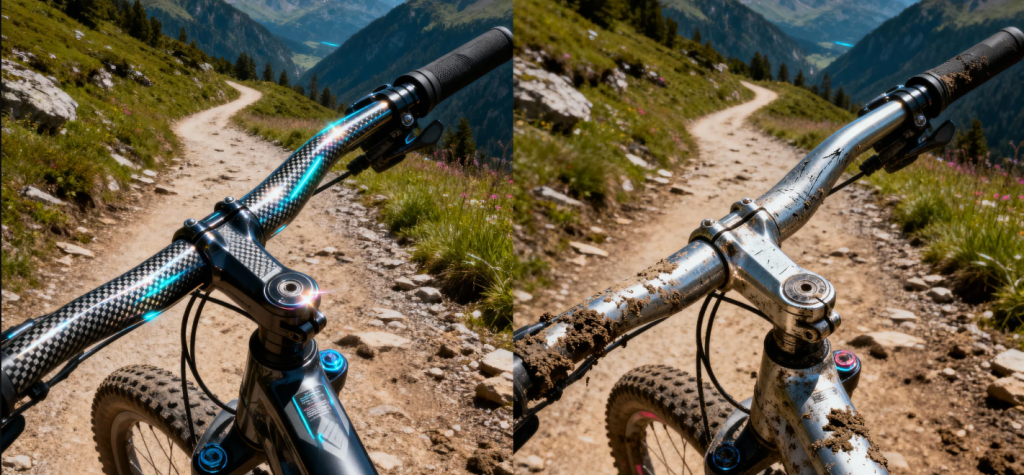
Carbon Fiber MTB Handlebars: The Choice for Performance and Weight Savings
Carbon fiber mtb handlebars are the hallmark of modern, high-performance mountain bikes. They are manufactured using precise carbon fiber layups to deliver ultimate performance advantages.
PS. Did you know that Toray: the world’s leading carbon fiber,supplying Boeing, BMW and otherenterprises, covering the full range ofproductsT800-T1100.

Pros
- Extreme Lightweight: Significantly lighter thanaluminum, often saving 100g or more-crucial forclimbing.
- Superior Damping: Effectively absorbs high-frequency trail chatter, reducing hand and armfatigue on long rides.
- High Stiffness-to-Weight Ratio: Provides necessaryrigidity while staying light, leading to a quickersteering response.
- Tunable Compliance: Manufacturers can adjust thefiber orientation to make the bar stiffer in somedirections (for control) and more compliant in others(for comfort).
Cons
- Higher Cost: Manufacturing is expensive.typically costing 2-4 times more than aluminumbars.
- Torque Sensitive: Must be installed strictlyfollowing torque specs (usually 5 N.m);overtightening can cause structural damage.
- Prone to Catastrophic Failure: Under severe,sharp impact (like hitting a rock during a crash),carbon can fracture suddenly and fail withoutwarning.
- Damage Hard to Assess: Damage may notalways be visible, requiring more specializedinspection.
What problems do carbon fiber handlebars solve?
If you’re an XC mountain biker, they address your pursuit of extreme lightness and climbing efficiency.
For endurance riders tackling long rides, they absorb road vibrations to reduce arm fatigue and prevent long-term strain.
For customization enthusiasts prioritizing feel and rigid response, they deliver more direct, precise handling.
Aluminum MTB Handlebars: Reliability and Budget Balance
Aluminum mtb handlebars are the most common and proven choice on the market. They are typically made from 6061 or 7075 aluminum, known for their reliability, durability, and cost-effectiveness.
Pros
- Robust and Reliable: Less prone to sudden failure; willtypically bend rather than snap, offering a safer, morepredictable failure mode.
- Affordable Price: Easy to mass-produce, offeringexcellent value, ideal for budget-concern riders.
- High Installation Tolerance: Less sensitive toinstallation torque than carbon, making them easier toinstall and adjust.
- Damage Easily Assessed: Visible bends or dents clearlyindicate the need for replacement.
Cons
- Heavier Weight: About 100-150 gramsheavier than a comparable carbon bar.
- More Vibration Feedback: Less effective atdamping trail chatter, which can lead toincreased hand fatigue. We will discuss soon.
- Potential Flex: Can feel slightly less rigidduring high-intensity sprints or when heavilyloaded.
What problems are aluminum alloy handlebars designed to solve?
If you’re a downhill or freeride rider: You require extremely high impact tolerance and prefer materials that bend rather than break when damaged.
If you’re a budget-conscious beginner or an experienced rider on a tight budget: You seek reliable performance and great value for money.
If you’re an adventurer (who crashes often): Aluminum offers lower replacement costs and greater resistance to scratches and impacts.
Scientific Support: Stiffness, Damping, and Failure
The performance differences between carbon fiber mtb handlebars and aluminum mtb handlebars are not anecdotal; they are rooted in fundamental materials science and industry testing standards (such as ISO 4210).
Stiffness and Handling: Modulus and Anisotropy

Material
Carbon Fiber
Key Scientific Principle
High Modulus & Anisotropy
Impact on Handling
Carbon fiber has an extremely high tensile strength. Through strategic layups, manufacturers can control the bar’s stiffness in specific directions (e.g., fore/aft) to make it highly rigid under load, resulting in more direct and precise steering response and higher Torsional Stiffness ratings.
Aluminum
Lower Modulus & Isotropy
Aluminum has a lower elastic modulus, meaning it requires thicker walls to achieve comparable stiffness, leading to significant weight increases. Its rigidity is uniform (isotropic), making directional optimization impossible.
Damping and Comfort: Material Damping Properties
Carbon Fiber: The carbon fiber composite material possesses inherently high damping properties. Its fibers and resin matrix work at a microscopic level to absorb and dissipate high-frequency vibration energy as heat, rather than transmitting it to the rider. This creates a “quieter” ride that significantly reduces hand fatigue.
Aluminum: Aluminum is a highly conductive metal with low internal damping. It tends to transmit the majority of high-frequency vibrations directly to the rider, which is the primary reason aluminum bars feel “harsher.”

Failure Mode and Safety: Yield Strength
Aluminum (Predictable Failure): When approaching its yield strength, aluminum undergoes plastic deformation (bending) before failure. This gradual stress concentration gives the rider a warning, considered a “predictable failure” mode.
Carbon Fiber (Catastrophic Failure): Carbon fiber has extremely high tensile strength, but when subjected to an impact that exceeds its design limits—especially sharp forces or over-torquing—the composite structure can fail instantly. This is why professional installation (using a torque wrench) and regular checks are absolutely vital for carbon fiber mtb handlebars.
Recommendations
When choosing the right handlebars for your mountain bike, the decision primarily comes down to your riding style, priorities, and budget. Here is a summary to guide your choice between aluminum and carbon fiber.
If your main focus is on Budget and Reliability, then Aluminum MTB Handlebars are the recommended choice. The rationale is that they are affordable, highly durable, and provide clear warning signs of damage, such as bending, before failing completely.
If your Focus is on Weight and High Performance, you should opt for Carbon Fiber MTB Handlebars. The reason is that they are significantly lighter and offer a higher stiffness-to-weight ratio, which directly boosts climbing efficiency and handling precision.
For riders who experience Frequent Long-Distance Riding and Hand Numbness, Carbon Fiber MTB Handlebars are again the ideal selection. Their superior vibration damping dramatically reduces rider fatigue, making them perfect for long hours in the saddle.
However, if you are into Heavy Downhill or Freeride Riding, the recommendation shifts back to Aluminum MTB Handlebars. Although carbon fiber is very strong, aluminum has a more predictable failure mode in the event of a severe crash, offering more forgiveness and critical reaction time.
Finally, for those planning a DIY Installation without a Torque Wrench, Aluminum MTB Handlebars are the necessary and safer option. Carbon fiber handlebars are extremely sensitive to installation torque, and professional installation with specialized tools is an absolute requirement to ensure safety.